

Đề cương ôn tập học kì 1 môn Tiếng Anh lớp 8 - Trường THCS Hợp Đức
1. Intended Future and Future Simple
2. The differences between intended future and future simple:
3. Past simple tense
Past habit: S + used to + V
Eg: He used to go swimming when he was young.)
4. Past progressive tense
5. present perfect tense
6. Enough .. to: S + be (not) + adj+ enough (+ for + O) + to Inf .
- Đồng chủ ngữ: Nam is not old. He is in my class.
Nam is not old enough to be in my class.
- . Khác chủ ngữ: This book is very interesting. You should read it.
This book is interesting enough to for you to read.
 16 trang
11540
16 trang
11540
Bạn đang xem tài liệu "Đề cương ôn tập học kì 1 môn Tiếng Anh lớp 8 - Trường THCS Hợp Đức", để tải tài liệu gốc về máy hãy click vào nút Download ở trên.
Tóm tắt nội dung tài liệu: Đề cương ôn tập học kì 1 môn Tiếng Anh lớp 8 - Trường THCS Hợp Đức
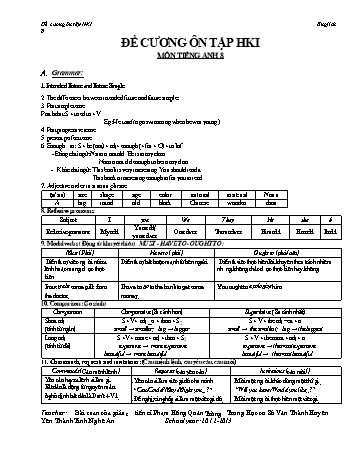
(ph¶i) Ought to (ph¶I nªn) DiÔn t¶ sù viÖc ngêi nãi ra lÖnh hoÆc mong ®îc thùc hiÖn DiÔn t¶ sù b¾t buéc m¹nh tõ bªn ngoµi DiÔn t¶ viÖc thùc hiÖn lêi khuyªn theo tr¸ch nhiÖm nhng kh«ng ch¾c ®îc thùc hiÖn hay kh«ng I must take some pills from the doctor. I have to go to the bank to get some money. You ought to apologize him 10. Comparison: (So s¸nh) Comparison Comparative (So s¸nh h¬n) Superlative ( So s¸nh nhÊt) Short adj ( tÝnh tõ ng¾n) S +V+ adj _er + than + S2 small → smaller; big → bigger S + V + the adj –est + n small → the smallest; big → the biggest Long adj ( tÝnh tõ dµi) S +V+ more + adj + than + S2 expensive → more expensive beautiful → more beautiful S + V + the most + adj + n expensive → the most expensive beautiful → the most beautiful 11. Commands, requests and invitations: (C©u mÖnh lÖnh, c©u yªu cÇu, c©u mêi) Commands (C©u mÖnh lÖnh ) Requests (c©u yªu cÇu ) Invitations (c©u mêi() Yªu cÇu hay ra lÖnh ai lµm g×. B¾t ®Çu lµ ®éng tõ n... those expressions :in the world,in the sky,. 4. Above: cao hon ,tren(nhung khong nhat thiet phai ngay tren) Ex: We were flying above the clouds. * Over:ngay tren(nhung tiep xuc) Ex:Lan lives in an apartment over the store. 5.Below: thap hon,duoi (nhung khong nhat thiet phai ngay duoi) Ex: The lake is almost 900 feet bolow sea level. *Under: duoi ,ngay duoi Ex: My puppy is sleeping under the table. 6.Near=beside=next to =by: gan ,ben canh Ex:Don’t sit near the door 7.Inside#Outside :ben trong#ben ngoai Ex:Let’s go inside the house He was sitting at a table outside the café 8.Between:o giua(2 nguoi hay 2 vat) Ex:Who is the girl standing between Alice and Mary. *Among: o giua(1 dam dong nguoi hay vat) Ex: She was sitting among a crowd ò the children. 9.Against:tua vao 10.In front of:phía trước 11.Behind:phía sau 12.Opposite:Đối diện 13.For:trong 14.Since:từ,từ khi 15.Fromto:từ.đến 16.By: trước hoặc vào 1 thời điểm nào đó 17.Before#after:trước # sau 18.With:với 19.Up#down:lên#xuống 20.About:quanh quẩn đâu đó 21.into:vao,vao trong,thanh 13. Used to: Used to +V(inf) àI used to go to school in the afternoon. Ex:I used to look after my younger brother Another example: We used to live a city but now we are living in a village. àForm: used to+V(inf) *Meaning: used to+V(inf) Có nghĩa trước đây thường /đã từng làm gì nhưng bây giờ không còn nữa. B.Exercises: I.Choose the best answer: Would you (like / love / want) to go with me? I’d love to. Her mother (left / leave / is leaving) this city two years ago They enjoy (tell / telling / told) jokes. The children are old enough to look after (themselves / herself / ourselves) We ought (put / putting / to put) the wardrobe opposite the bed. You’ll have to cook dinner (yourself / myself / ourselves) They’ll arrive (in / on / at) Monday, 11th July We must be there (at / after / between) 7.30 and 9.30. They want to know (why / where / what) she left early. D... and B 12. - Lan doesn’t talk much in public. She’s rather --------- in public. A. reserved B. silent C. talkative. D. sociable 13- Deaf-mutes can _______speak _______hear. A . both.and B. neithernor C. not only but also D . either or 14- You’ll _________ cook dinner yourself A. have to B. ought to C.must D. should 15- Would you like________ a message? A . leave B. to leave C. leaving D. left III. Fill in the blank with the correct form of verbs: 1. Would you like (listen)..............................to some music? Yesterday, Ba ( go).............................to Da Nang by car. Nam enjoys ( play)..........................soccer after school. Lan asked me (go).........................to the supermarket. Mai is (buy)...............................a new bicycle next week. I think you should (do)...............................the morning exercise. They used (go) ........................................to work by train. Don’t let children (play)..........................................alone. You ought to (do)..............................................the homework yourself. My father stopped (smoke).................................................... Mai has enough money (buy).........................................a new bicycle. Hoa often (do)............................................the homework after school. Look! A baby (cross)...............................................the road. I need (buy)................................................some notebook. My teacher said I should (spend)...........................more time on my English. Mr Hung told me (tell)............................................him the truth. Nga likes ( play)............................................... badminton. They asked their children ( stay)........................at home. Nam must (do)............................................the homework himself. My mother (buy).............................................a house last week. IV. Co
File đính kèm:
- de_cuong_on_tap_hoc_ki_1_mon_tieng_anh_lop_8_truong_thcs_hop.doc


